

Search has fundamentally changed—and most manufacturing websites haven’t kept up.
Many industrial companies are still relying on outdated SEO playbooks: keyword stuffing, thin product pages, and generic backlinks. Meanwhile, AI-generated search results, entity-based indexing, EEAT signals, and role-driven buyer behavior are reshaping how engineers and procurement teams discover suppliers.
If your goal is organic traffic growth, stronger brand authority, and warming up top-of-funnel leads for retargeting and email nurturing, your strategy must evolve.
In this guide, you’ll learn future-ready SEO strategies for manufacturers built specifically for 2026, including:
- AI and generative search optimization
- Role-based keyword targeting
- Technical SEO for large product catalogs
- EEAT and authority-building frameworks
- Actionable checklists for implementation
Let’s close the gap between outdated tactics and what modern industrial SEO actually requires.
Why SEO for Manufacturers Is Different in 2026

Manufacturing SEO has always been unique. In 2026, the differences are even more pronounced.
B2B Complexity vs. B2C Simplicity
Consumers search quickly and buy emotionally. Industrial buyers evaluate:
- Technical tolerances
- Compliance standards
- Production capabilities
- Material specifications
- Long-term supplier reliability
A homeowner might search “best kitchen sink.”
An engineer searches “corrosion-resistant stainless steel fabrication for marine environments.”
Your SEO must reflect that technical specificity.
AI-Powered Search Is Changing Discovery
Generative AI now summarizes search results. If your content isn’t structured, clear, and authoritative, it won’t be cited.
Common competitor gaps:
- No optimization for AI overviews
- No structured FAQs
- No entity-driven SEO
- Weak EEAT signals
The future of SEO for manufacturers is about clarity, expertise, and machine-readable authority.
Multiple Decision Makers, Longer Sales Cycles
Manufacturing purchases often involve:
- Engineers
- Procurement managers
- Plant supervisors
- Operations leaders
- Executives
Each searches differently. Yet many competitors create content for “one generic buyer.”
That’s a strategic mistake.
Strategy #1 – AI-Optimized Keyword Research for Industrial Buyers

Keyword research in 2026 is about intent modeling—not just volume.
Search Intent Beyond Keywords
Modern industrial queries look like this:
- “How to reduce vibration in CNC machining”
- “Best material for high-pressure hydraulic components”
- “5-axis vs 3-axis machining cost comparison”
AI engines interpret meaning, not exact-match keywords.
Action Checklist
- Identify problem-based search queries
- Map informational vs commercial vs comparison intent
- Use conversational long-tail keywords
- Build intent clusters instead of isolated pages
Mapping Keywords to Buyer Roles
One of the biggest content gaps in manufacturing SEO is failing to target roles.
Buyer Journey Visualization
Role-Based Keyword Examples
Engineers Search:
- “ISO 2768 tolerance chart”
- “CNC aluminum surface finish standards”
Procurement Searches:
- “How to qualify a CNC machining supplier”
- “ISO 9001 certification requirements”
Executives Search:
- “Reducing fabrication costs through automation”
- “ROI of domestic vs offshore manufacturing”
Action Checklist
- Create keyword sets for each buyer role
- Align keywords with funnel stages
- Build persona-specific content clusters
- Track rankings by persona category
Get a Free SEO website Audit and discover exactly where your site stands in AI search visibility, technical performance, and buyer-intent coverage.
Strategy #2 – Topic Clusters Built Around Manufacturing Solutions

Legacy product pages aren’t enough anymore.
Pillar Pages vs. Product Pages
Instead of thin SKU pages, create solution-focused hubs.
Topic Cluster Model
Example:
Pillar Page:
Precision CNC Machining Solutions
Cluster Content:
- Materials guide
- Tolerance standards
- Industry applications
- Cost drivers
- Finishing options
This builds topical authority and improves AI citation probability.
Action Checklist
- Identify 5–10 core solution categories
- Create in-depth pillar pages
- Build 5–10 supporting articles per pillar
- Interlink strategically
Strategy #3 – Optimizing for Generative Search & AI Overviews
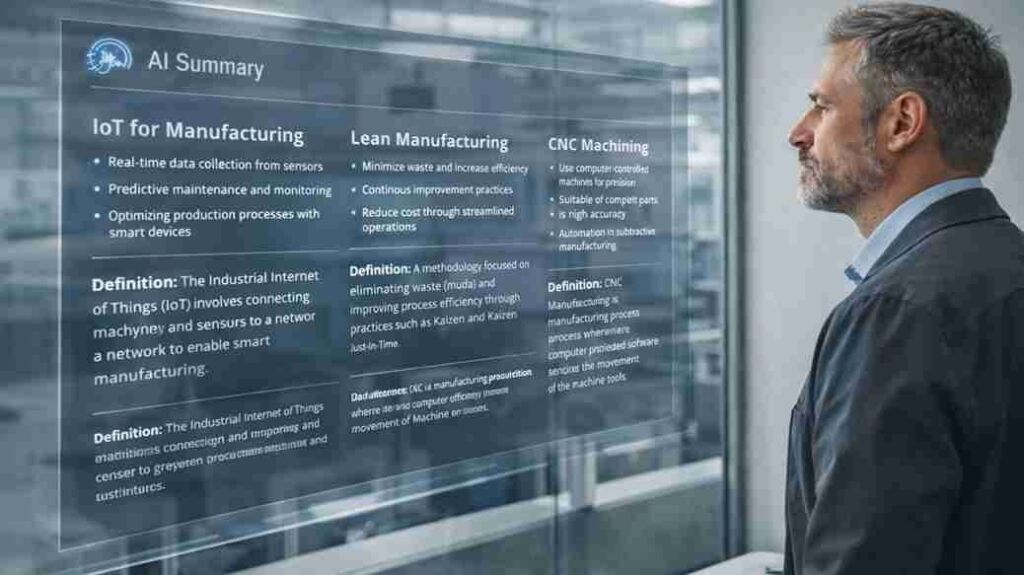
Generative search doesn’t “rank” pages—it synthesizes answers.
How AI Engines Pull Manufacturing Content
AI prioritizes:
- Clear headings
- Concise definitions
- Structured bullet lists
- Data tables
- Entity-rich language
If your specs live only inside PDFs, AI can’t easily extract them.
Structured Answers & Entity-Driven SEO
Example format:
What is 5-axis CNC machining?
5-axis CNC machining is a manufacturing process that moves a cutting tool across five axes simultaneously, allowing complex geometries and tight tolerances. It reduces setup time and is widely used in aerospace and medical industries.
Short. Direct. Structured.
Strengthening EEAT
Manufacturing SEO must demonstrate:
- Experience (real-world projects)
- Expertise (engineer authors)
- Authoritativeness (industry citations)
- Trustworthiness (certifications, case studies)
Action Checklist
- Add FAQ sections to solution pages
- Use structured schema markup
- Create detailed author bios
- Publish original research annually
Strategy #4 – Technical SEO for Large Manufacturing Websites

Large industrial catalogs require deep technical SEO.
Crawl Efficiency for Thousands of SKUs
Common issues:
- Duplicate variations
- Outdated products
- Broken links
- Parameter-heavy URLs
Technical Checklist
- Audit crawl depth (max 3–4 clicks)
- Consolidate duplicate product pages
- Use canonical tags
- Maintain updated XML sitemaps
- Redirect discontinued SKUs properly
Core Web Vitals for Industrial Sites
Manufacturing sites often suffer from:
- Heavy CAD files
- Large images
- Slow hosting
Improve:
- Image compression
- Lazy loading
- Server caching
- CDN usage
Technical strength ensures both rankings and usability.
Strategy #5 – Engineering-Focused Content That Builds Trust

Credibility drives visibility.
Spec Sheets, CAD Files & SEO
Best practice:
- Provide HTML summaries
- Include searchable specifications
- Optimize file metadata
- Add keyword-rich descriptions
Writing for Technical Credibility
Avoid vague claims. Instead use precise language:
“Our facility operates 12 five-axis CNC machines capable of ±0.002mm tolerances under ISO 9001:2015 standards.”
Specificity builds authority.
Content Checklist
- Reference industry standards
- Include measurable claims
- Add diagrams and process visuals
- Cite technical benchmarks
Strategy #6 – Local & Global SEO for Manufacturers

Manufacturers must balance regional presence and global visibility.
Multi-Location SEO
Each facility needs:
- Unique location pages
- Local certifications
- Optimized Google Business Profiles
- Regional keyword targeting
International & Multilingual SEO
- Implement hreflang tags
- Translate professionally
- Localize measurements
- Optimize country-specific domains
Action Checklist
- Audit location visibility
- Create region-specific landing pages
- Monitor international performance
- Adapt terminology per market
Strategy #7 – SEO-Driven Thought Leadership

Authority wins in AI-driven search.
Original Data & Industry Insights
Publish:
- Annual manufacturing trend reports
- Cost benchmarking studies
- Supply chain forecasts
- Automation adoption data
Original research earns backlinks and AI citations.
Executive Visibility & Author Authority
Showcase:
- Engineering leaders
- Operations directors
- CEO insights
Build detailed author pages with credentials.
Authority Checklist
- Publish one major industry report annually
- Build executive content strategy
- Guest publish in trade publications
- Host webinars with transcripts
Strategy #8 – Link Building in the Manufacturing Industry

Industrial link building must be strategic.
Trade Publications & Associations
Target:
- Industry magazines
- Engineering associations
- Manufacturing directories
Guest posts and case studies work best.
Digital PR & Supplier Partnerships
Leverage:
- Supplier announcements
- Innovation awards
- Equipment partnerships
Link Building Checklist
- Identify 20 relevant trade sites
- Pitch expert commentary
- Publish 3–5 guest contributions annually
- Secure supplier backlinks
Strategy #9 – Conversion-Ready SEO Content

Top-of-funnel traffic should warm leads.
Soft CTAs for Early Buyers
Instead of “Request a Quote,” try:
- Download the engineering checklist
- Access the material comparison guide
- Subscribe for manufacturing insights
SEO + Marketing Automation Alignment
Connect SEO to:
- Retargeting campaigns
- Persona-based email sequences
- CRM tracking
- Content-driven nurture flows
Conversion Checklist
- Add gated technical resources
- Track assisted conversions
- Align SEO reporting with CRM
- Segment audiences by interest
Strategy #10 – Measuring SEO ROI in Manufacturing

Traffic alone doesn’t prove value.
Metrics That Matter
Track:
- Organic-driven RFQs
- Marketing-qualified leads
- Sales-qualified leads
- Revenue influenced by organic
Attribution Across Long Sales Cycles
Manufacturing buyers engage with multiple touchpoints.
Use:
- Multi-touch attribution
- CRM integration
- Funnel-stage tagging
ROI Checklist
- Connect analytics to CRM
- Track first-touch and assisted conversions
- Measure pipeline influenced by SEO
- Review quarterly attribution reports
Final Thoughts: Future-Proofing Your Manufacturing SEO Strategy
The manufacturers that win in 2026 will not rely on outdated SEO tactics.
They will:
- Optimize for AI and generative search
- Target keywords by buyer role
- Build structured topic clusters
- Invest in technical depth
- Strengthen EEAT signals
- Connect SEO directly to pipeline revenue
Most competitors are still optimizing for yesterday’s algorithms.
If you’re ready to modernize your SEO strategies for manufacturers and build a sustainable growth engine for 2026 and beyond—Book a 30-Minute Manufacturing SEO Strategy Call